

Real-Time Production Tracking Isn’t Just for Large Factories
Real-Time Production Tracking Isn’t Just for Large Factories


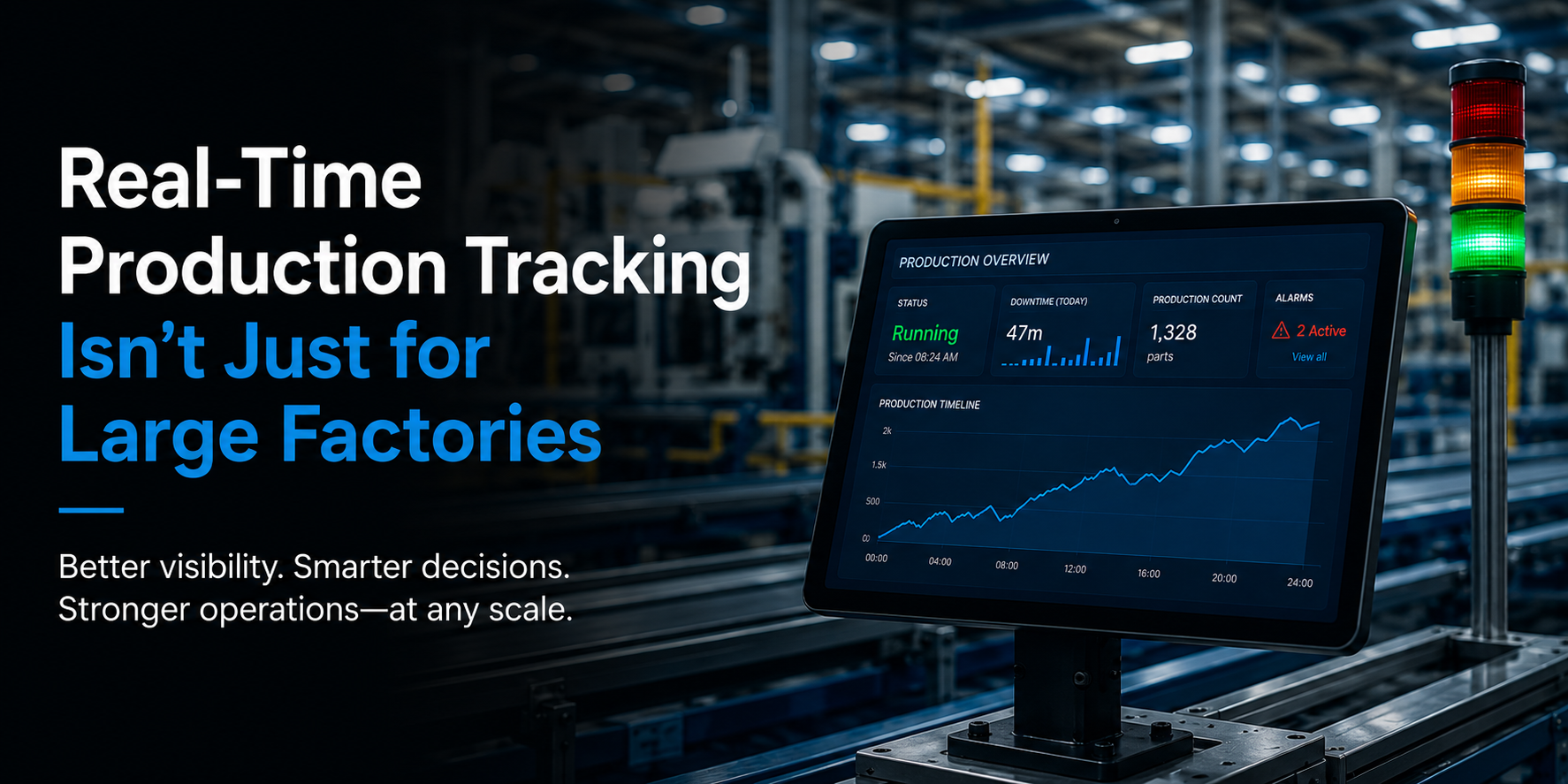
When people hear “production tracking” or “industrial monitoring,” they often imagine massive factories with hundreds of machines, dedicated IT teams, and million-dollar automation budgets.
But the reality is very different today.
Small and mid-sized operations often benefit from production tracking even more than large enterprises because every machine, every operator, and every minute of downtime matters more.
We’ve seen that many growing operations are still relying on whiteboards, spreadsheets, manual logs, or operator memory to understand production performance. While that may work temporarily, it becomes increasingly difficult to identify inefficiencies, recurring issues, or hidden production losses as operations grow.
The good news is that modern production tracking is no longer reserved for large corporations.
Why Smaller Operations Feel Downtime More Severely
In a large facility, losing one machine for an hour may only affect a small percentage of overall output.
In a smaller operation, that same hour of downtime can disrupt the entire day.
Smaller teams often operate with:
- tighter production schedules
- fewer backup machines
- smaller maintenance teams
- leaner staffing
- lower margin for error
This means even small interruptions can have a significant operational impact.
A recurring 5-minute stoppage may not seem critical at first, but if it happens dozens of times per week, it quietly reduces productivity, increases operator frustration, and creates scheduling problems downstream.
Without proper tracking, these small losses are rarely measured accurately.
The Problem With Manual Tracking
Many operations still depend on:
- handwritten production logs
- shift reports
- spreadsheets
- operator recollection
- verbal communication between shifts
The challenge is not that operators are doing something wrong it’s that manual reporting rarely captures the full picture.
Micro stoppages, intermittent faults, and short downtime events are often forgotten or normalized over time.
For example:
- a machine pauses for 2 minutes every cycle
- a sensor intermittently disconnects
- cycle times slowly increase over several weeks
- operators reset minor alarms without documentation
These issues are difficult to identify consistently without continuous monitoring.
Over time, small inefficiencies compound into major production losses.
Production Tracking Does Not Need to Be Complex
A common misconception is that production tracking requires:
- expensive infrastructure
- full factory automation
- large engineering teams
- months-long deployments
Modern systems can start much smaller.
In many cases, operations can begin by simply monitoring:
- machine downtime
- cycle counts
- alarm frequency
- production timelines
- basic machine status signals
Even limited visibility can immediately improve operational awareness.
The goal is not to create complexity.
The goal is to create clarity.
Visibility Changes Decision-Making
One of the biggest advantages of real-time tracking is that it replaces assumptions with measurable data.
Instead of asking:
“Why did production seem slower this week?”
Teams can answer:
- which machine stopped most frequently
- when downtime occurred
- how long stoppages lasted
- whether cycle times changed
- which alarms happened most often
This allows teams to move from reactive troubleshooting to proactive improvement.
Even simple visibility can help operations:
- reduce recurring downtime
- identify bottlenecks
- improve maintenance planning
- standardize operator workflows
- improve scheduling accuracy
Starting Small Is Often the Best Approach
Production tracking does not need to happen all at once, many successful implementations begin with a single machine or production line.
Once teams begin seeing:
- downtime trends
- recurring faults
- hidden production losses
- operational patterns
it becomes much easier to expand intelligently.
The most effective systems are often built incrementally:
- Track basic machine states
- Measure downtime
- Add production counts
- Introduce alarms and alerts
- Build operational context over time
This approach keeps implementation practical while still delivering immediate value.
Real-Time Monitoring Is Becoming Accessible
Historically, advanced manufacturing visibility was difficult for smaller operations to adopt.
Today, that barrier is much lower.
Modern industrial platforms can integrate with existing PLCs, SCADA systems, and machine signals without requiring complete infrastructure replacement.
This allows smaller manufacturers to gain operational insights that were previously only available to much larger organizations.
And as operational complexity grows, having accurate historical and real-time data becomes increasingly important.
Final Thoughts
You do not need a massive factory to benefit from production tracking.
In many cases, smaller operations have even more to gain from improved visibility because every machine, every shift, and every production hour carries greater weight.
The key is not starting with a perfect system.
The key is starting with visibility.
Even simple real-time tracking can uncover inefficiencies that manual reporting will never fully capture and those insights often become the foundation for better operational decisions, improved productivity, and long-term growth.
Want to learn more?
Case Studies
How Leading Companies Transform their Operations
Real-world examples of operational excellence achieved through our platform
Drive measurable results. Without operational friction.