

The Cost of Waiting for the Shift Report
The Cost of Waiting for the Shift Report


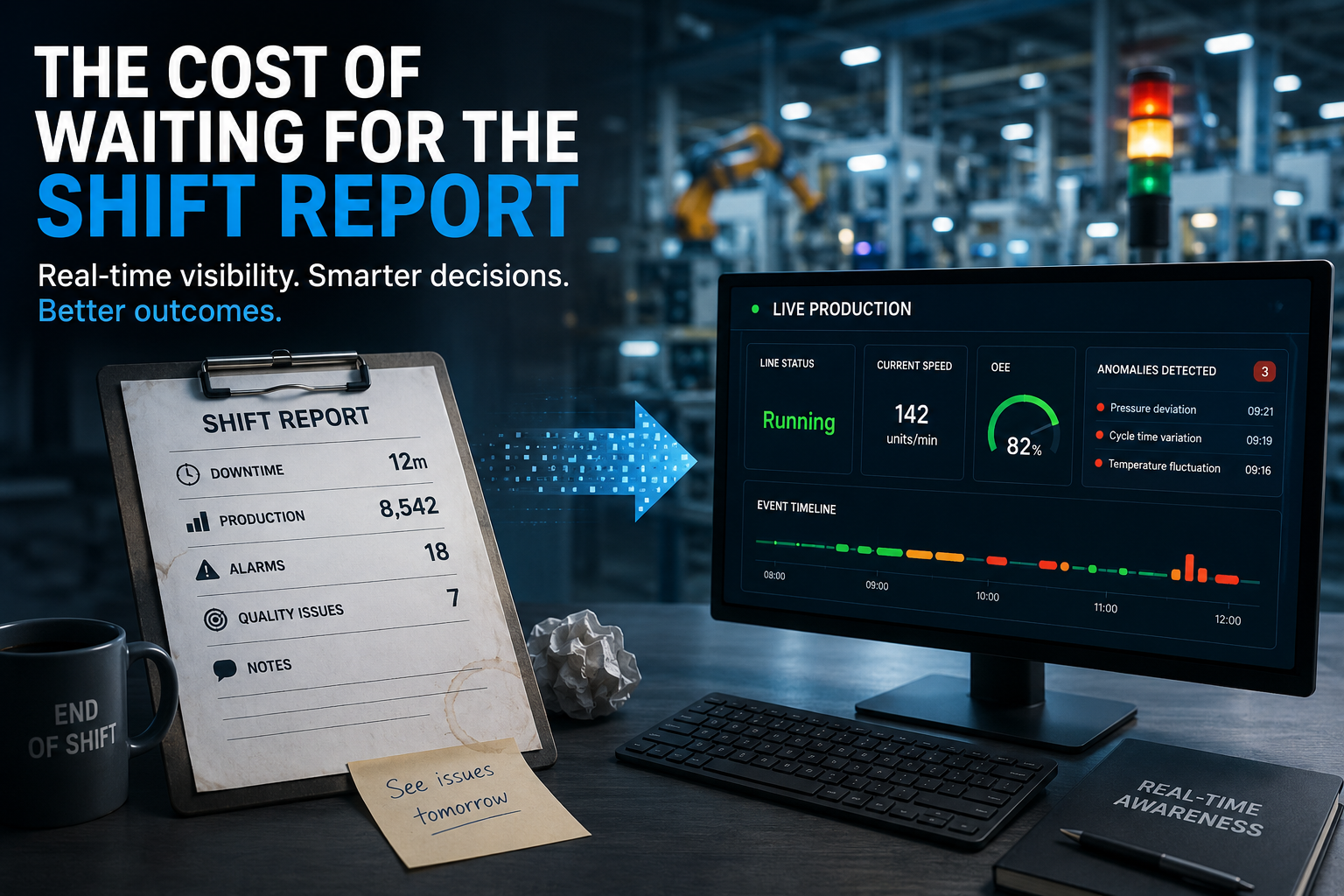
In many manufacturing environments, operational decisions are still heavily influenced by shift reports.
At the end of the shift, teams review:
- Downtime events
- Production counts
- Alarms
- Quality issues
- Operator notes
The report becomes the official story of what happened during production, but there is a problem:
By the time the shift report is reviewed, the opportunity to react has often already passed.
Production Problems Rarely Start All at Once
Operational issues usually begin as small changes long before a major stop occurs.
A machine may start showing:
- Slight cycle inconsistencies
- Small speed losses
- Repeated operator adjustments
- Minor process instability
- Short interruptions that quickly recover
Individually, these events may not seem important, but together they often form the early stages of a larger operational problem.
When visibility only arrives after the shift ends, teams are forced to analyze history instead of understanding what is happening in real time.
Aggregation Removes Context
Shift reports are important, but they are still summaries of operational behavior.
And every time data is aggregated some level of context disappears some things get hidden like:
What often gets hidden:
- Short interruptions
- Sequence of events
- Process instability
- Operator corrections
- Signal relationships
- Early indicators before downtime
By the time information reaches a shift report, the process has already been compressed into simplified metrics with no context.
The machine may have generated thousands of operational events during that period, but only a small portion becomes visible in the final report.
That missing context is often where the root cause actually lives.
The Problem with Looking Backward
Most shift reports answer questions like:
- How much downtime occurred?
- How many units were produced?
- Which alarms were triggered?
- How long was the line stopped?
These are important metrics, but they mainly describe the outcome of the shift.
They rarely explain how the process evolved leading up to the event, for example a report may simply state:
“Line stopped for 12 minutes.”
But the operational story may have started much earlier:
- Repeated microstops
- Rising cycle variability
- Intermittent sensor instability
- Increasing operator intervention
- Small process deviations building over time
Without that sequence, root cause analysis becomes significantly harder and a lot of times inaccurate.
Real-Time Visibility Changes the Conversation
When operational data becomes visible in real time the focus shifts.
Instead of asking: “What happened during the shift?”
Teams can begin asking: “What is happening right now?”
Real-time visibility allows manufacturers to:
- Detect abnormal behavior earlier
- Investigate issues with full context
- Identify patterns before escalation
- Reduce troubleshooting time
- Improve collaboration between operations and maintenance
The goal is not to collect more data, the real goal is reducing the delay between operational behavior and operational awareness.
The Machine Already Contains the Story
Most of the information needed to understand production issues already exists inside the equipment itself.
The challenge is not data availability but visibility. When systems rely only on delayed summaries or heavily aggregated reporting, important operational behavior disappears.
The closer you get to the machine itself, to the PLC, the signals, the event sequence the clearer the process becomes.
Visibility Changes Response Time
Modern manufacturing systems generate far more operational data than ever before.
The challenge is no longer collecting information, it’s making the right operational context visible early enough to act on it.
As manufacturing continues moving toward real-time analysis and response, the ability to understand process behavior while it is happening not hours later in a report is becoming increasingly important.
Because the earlier operational drift becomes visible, the easier it becomes to investigate, react, and improve outcomes.
Want to learn more?
Case Studies
How Leading Companies Transform their Operations
Real-world examples of operational excellence achieved through our platform
Drive measurable results. Without operational friction.