

The Silent Goldmine: Why Most Manufacturing Data Goes Unused
Most manufacturing plants generate massive amounts of data but fail to turn it into insight. Discover how to unlock hidden value by transforming operational data into predictive decision intelligence.


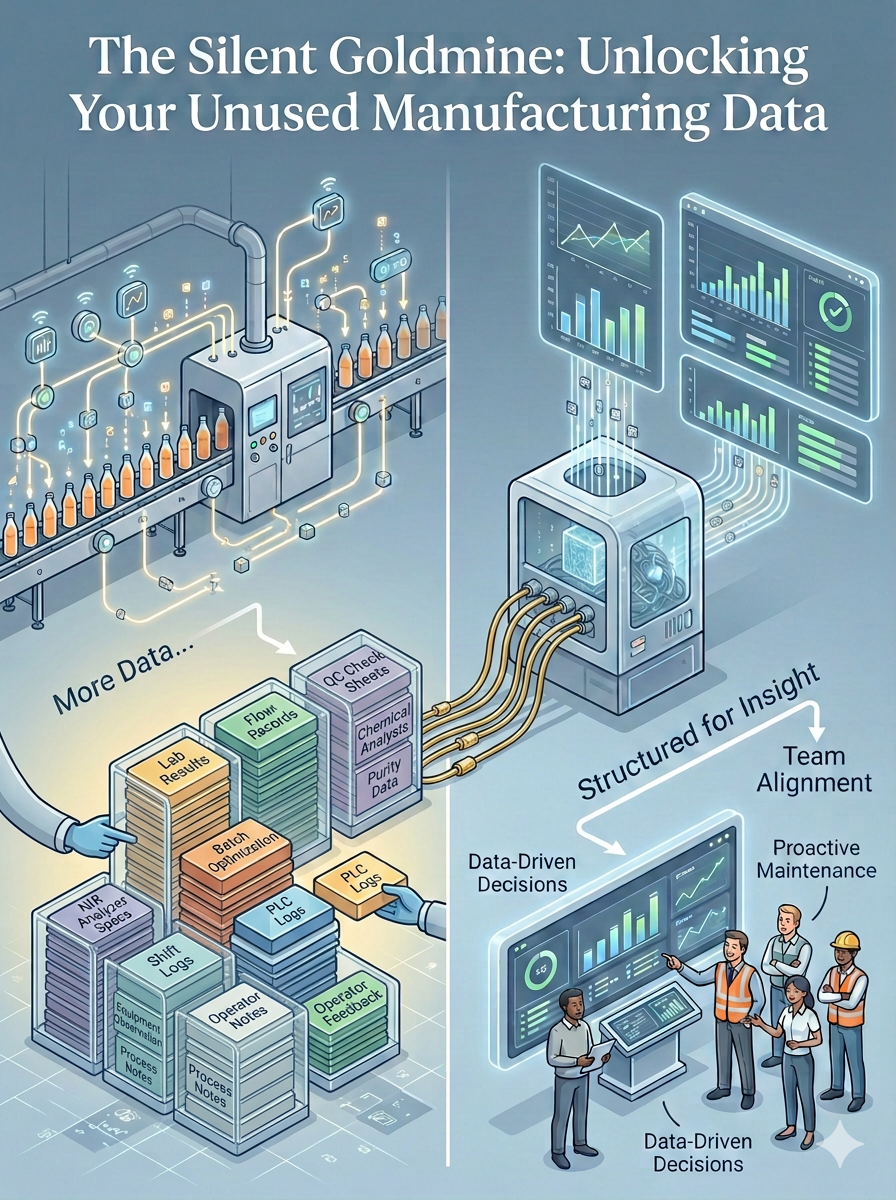
Walk into any modern manufacturing plant and you’ll find sensors everywhere.
Temperature probes.
Flow meters.
Pressure transmitters.
NIR analyzers.
Vibration monitors.
PLC logs.
Batch records.
Every second, thousands of data points are generated.
And yet most of it is never truly used.
Not because it isn’t valuable.
But because it isn’t structured for decisions.
The Data Paradox in Manufacturing
Manufacturing companies invest heavily in automation and instrumentation. Over time, plants accumulate years of:
- Batch data
- Quality results
- Downtime logs
- Alarm histories
- Maintenance records
- Operator notes
- ERP production data
The paradox?
The more data we collect, the harder it becomes to extract insight from it.
Instead of clarity, teams often get:
- Overloaded dashboards
- Endless spreadsheets
- Reactive troubleshooting
- Knowledge trapped in people’s heads
The plant becomes data-rich but insight-poor.
What Usually Happens to the Data?
In most facilities, data falls into three categories:
1. Data That Is Monitored but Not Analyzed
Operators watch temperature and pressure trends.
If something goes wrong, they react.
But no one systematically asks:
- What did our best batches look like?
- What signals drift before quality deviations?
- Are we slowly losing efficiency?
Monitoring is not optimization.
2. Data Stored for Compliance
Batch reports are archived.
Quality logs are saved.
Audit trails are preserved.
But rarely mined.
The information exists but only gets opened when something breaks.
3. Data That Exists but Is Forgotten
This is the most expensive category.
- A maintenance issue solved two years ago.
- A specific moisture threshold that caused yield loss.
- A temperature combination that improved texture.
- An NIR pattern that predicted instability.
Someone figured it out once.
But that insight never became institutional memory.
So the same problem is solved again… and again… and again.
The Real Cost of Unused Data
Unused data doesn’t just sit quietly.
It costs:
- Lower yield
- Higher energy consumption
- More rework
- Slower troubleshooting
- Inconsistent quality
- Operator dependency
- Delayed decisions
Most importantly, it costs confidence.
When decisions rely heavily on experience instead of evidence, scaling becomes fragile.
The Shift: From Data Collection to Decision Intelligence
The future of manufacturing is not about adding more sensors.
It’s about activating the sensors you already have.
That shift includes:
1. Learning from Your Best Batches
Instead of defining “good” based on a spec sheet,
define it based on historical top-performing production runs.
Let the system detect deviations from your real-world optimal behavior.
2. Connecting Quality to Process Signals
Moisture is 54%.
Is that good?
Bad?
Acceptable?
Now add context:
- Recipe guidelines
- Past incidents
- Similar historical batches
- Operator feedback
- Equipment conditions
Data becomes knowledge when it is connected.
3. Turning Historical Data into Predictive Patterns
Signals drift before failures.
Processes destabilize gradually.
Energy usage creeps up.
The patterns are there.
But humans are not built to scan millions of time-series points.
Algorithms are.
4. Preserving Operational Memory
Imagine if your plant could answer:
- “When was the last time this happened?”
- “What did we do to fix it?”
- “Did it work?”
- “Who handled it?”
- “What were the conditions?”
That’s not just data.
That’s accumulated intelligence.
The Competitive Advantage No One Talks About
Most manufacturers compete on:
- Raw materials
- Equipment
- Labor efficiency
- Supply chain
But the next major advantage will be:
Decision speed powered by data.
Not just dashboards.
Not just alerts.
But structured insight that:
- Detects anomalies early
- Explains why they matter
- Connects to past outcomes
- Recommends action
The Opportunity Is Already Inside Your Plant
The surprising truth?
You likely don’t need more data.
You need:
- Better correlation
- Better contextualization
- Better pattern detection
- Better knowledge capture
The raw material is already there.
Hidden in your historian.
Stored in your PLC.
Archived in your batch reports.
Buried in your PDFs.
The goldmine is not outside.
It’s already inside your factory.
Want to learn more?
Case Studies
How Leading Companies Transform their Operations
Real-world examples of operational excellence achieved through our platform
Drive measurable results. Without operational friction.