

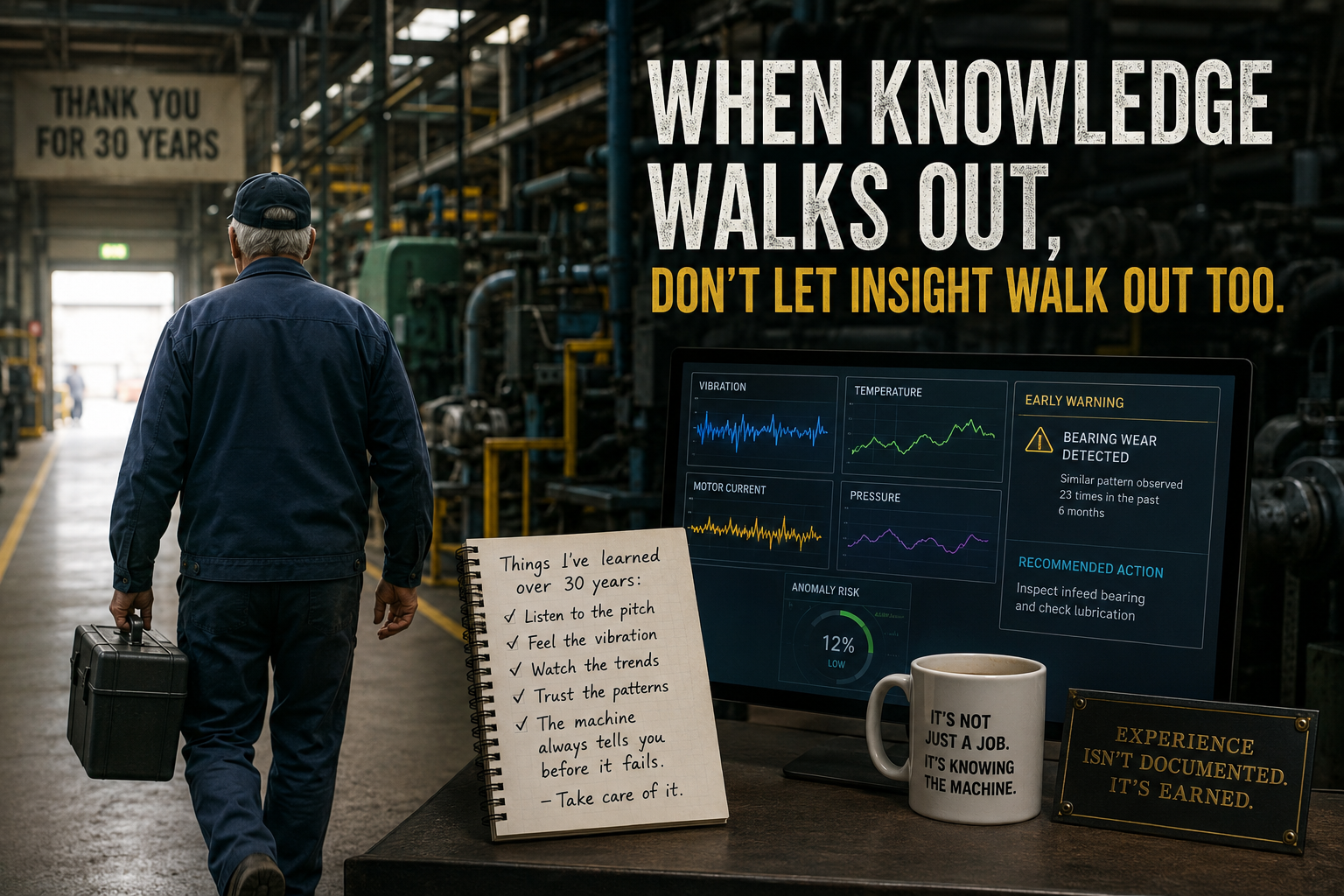
Every plant has one. The operator who can walk past a line and tell you something is wrong before any gauge does, they hear it in the pitch of a motor. Ask them how they know and they shrug, after thirty years they just know.
When that person is on shift, the line runs well. Problems get caught early. The hard to diagnose faults that would stump anyone else get sorted in twenty minutes. Everyone relies on them, often without realizing how much.
Then they retire.
The most valuable asset in the building has no backup
We spend enormous effort protecting against single points of failure in equipment. We map out what happens if a given machine goes down and we plan around it.
We rarely apply the same thinking to people. Yet the operator who "just knows" the machine is exactly that, a single point of failure. The difference is that when a pump fails you can order another one. When that knowledge walks out the door for the last time, there is nothing on the shelf to replace it.
And this is not a distant risk. The manufacturing workforce is aging, and a large share of the most experienced people on the floor are within a few years of leaving. The knowledge they carry was built over decades, and it tends to leave the way it arrived, quietly and all at once.
Documentation was supposed to fix this. It didn't.
The standard answer is to write it down. Build the SOPs, update the work instructions, capture the procedures. Plenty of plants have done exactly that, and the binders are real.
The problem is that the valuable knowledge is not procedural. An SOP can tell you the steps to change a tool. It cannot tell you that this particular machine tends to drift after a material change, or that the second shift's product runs a little tighter, or that when you hear a specific rattle you should check the infeed before anything else. That kind of knowing is built from thousands of small observations connected over time. It lives in judgment, not in steps, and judgment is exactly what documentation struggles to hold.
So the binder captures what to do and loses the part that actually mattered: why, and when, and what to watch for.
The real question is about the process, not the person
It is tempting to treat this as a staffing problem. Hire earlier, overlap the retiring expert with a replacement, hope enough rubs off. That helps, but it assumes the next person will spend another thirty years building the same intuition before they too become irreplaceable. You have not removed the single point of failure. You have only scheduled it for later.
The more useful question is different. What would it take for the understanding itself to live in the process rather than in one person's head? Not the steps, but the patterns. The relationships between what a machine is doing and what is about to go wrong. The signals the veteran reads without thinking.
That understanding exists in the data the plant already produces. The pitch change, the vibration, the slow drift after a material swap, all of it shows up in the signals long before it shows up as a failure. The veteran learned to read those patterns by living alongside them for years. The opportunity now is to make that same reading available continuously, to everyone on every shift, without waiting thirty years for the next person to acquire it the hard way.
This is what continuous monitoring of a machine and its process is really for. Not another dashboard of numbers, but a system that watches the line the way the veteran does, learning what normal sounds like and noticing the moment it starts to slip. When a platform like MontBlancAI tracks those signals over time, the drift after a material change or the early sign of a bearing going bad stops being something only one person can catch. It becomes something the process itself surfaces, on every shift, whether or not the right person happens to be standing nearby. The intuition no longer has to be rebuilt from scratch each time someone leaves. It accumulates.
What stays when they leave
The goal is not to replace the person who just knows. People like that are why plants run at all, and their instinct deserves more respect than a binder ever gave it. The goal is to make sure that when they finally do leave, what they understood about the process does not leave with them.
The machine will still be there the day after they retire. The real question is whether anyone will still know what it is telling them.
Want to learn more?
Case Studies
How Leading Companies Transform their Operations
Real-world examples of operational excellence achieved through our platform
Drive measurable results. Without operational friction.