


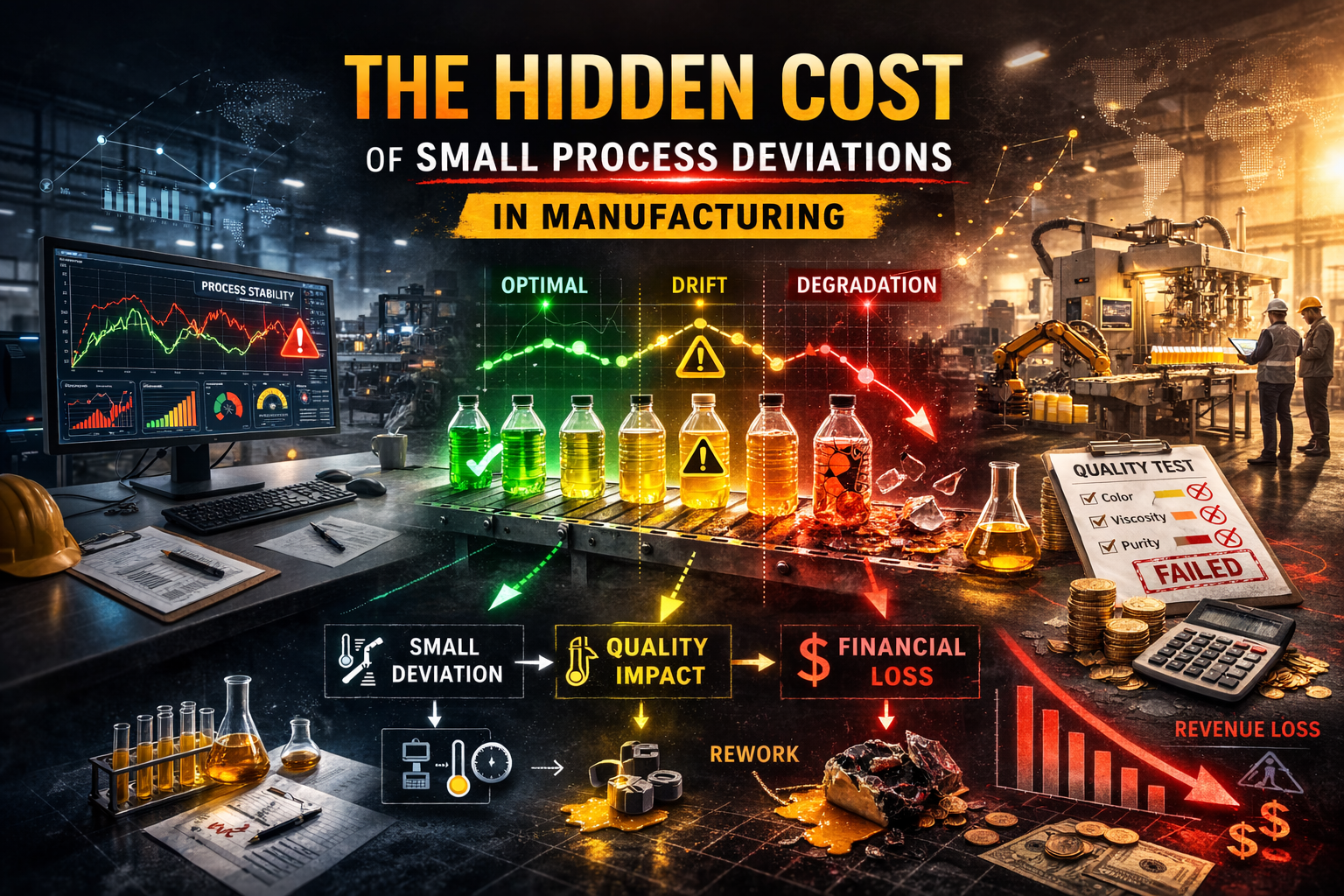
Small deviations don’t usually cause immediate failure.
Instead, they create gradual inefficiencies that are harder to detect but equally damaging.
1. Product Downgrades
A batch completes successfully.
No alarms were triggered.
But quality results come back slightly off.
The product can no longer be sold at its premium price.
It gets downgraded.
Even a small percentage of downgraded batches can translate into significant revenue loss over time.
2. Yield Reduction
Subtle process drift can reduce extraction efficiency, increase waste, or lead to rework.
These losses are often written off as “normal variation.”
But across hundreds of batches, they add up to substantial material loss.
3. Increased Energy Consumption
Processes operating outside optimal conditions often consume more energy.
Heating systems work harder.
Pumps run longer.
Cooling cycles become inefficient.
The cost increase is gradual and often goes unnoticed.
4. Hidden Downtime and Micro-Stops
Small inconsistencies can create minor interruptions:
- brief slowdowns
- operator adjustments
- short pauses in production
Individually insignificant.
Collectively, they reduce overall throughput and equipment effectiveness.
5. Operator Dependency
When processes are not tightly controlled, performance depends heavily on operator experience.
Some shifts perform better than others.
Some deviations are corrected quickly, others are missed.
This creates inconsistency and limits scalability.
Why Traditional Monitoring Misses It
Most manufacturing systems are designed to detect when something breaks.
They rely on:
- fixed alarm thresholds
- dashboards
- historical reports
- periodic quality testing
These tools are essential but they have a limitation.
They only detect large deviations.
Small process shifts often remain invisible because:
- they stay within acceptable limits
- they affect multiple signals slightly instead of one signal significantly
- their impact is only visible later in quality or performance metrics
By the time the issue becomes clear, the opportunity to correct it has already passed.
The Missing Link: Context
One of the biggest reasons these losses persist is a lack of connection between different types of data.
Production systems generate thousands of data points:
- temperatures
- pressures
- flows
- speeds
- timing
Meanwhile, other systems track outcomes:
- quality results
- lab measurements
- yield
- downtime
- production output
But these datasets are rarely analyzed together in a meaningful way.
Without connecting process behavior to outcomes, it becomes extremely difficult to answer key questions:
- Which deviations actually impact product quality?
- When did the process begin drifting?
- Which signals provide early warning signs?
This lack of context keeps teams in a reactive mode.
A Different Approach: Detecting Deviations Early
Instead of waiting for thresholds to be exceeded, modern approaches focus on detecting changes in behavior.
By analyzing historical production data, it is possible to understand what normal operation looks like across multiple signals simultaneously.
When this data is combined with quality and performance outcomes, patterns begin to emerge:
- which signal behaviors lead to product degradation
- which conditions reduce yield
- which patterns precede inefficiencies
This allows systems to detect subtle deviations as soon as they begin to develop.
Not after the damage is done but while there is still time to act.
From Reactive to Proactive Operations
When small deviations are detected early, the entire operating model changes.
Instead of:
→ investigating problems after production
→ analyzing reports after the fact
→ reacting to quality failures
Teams can:
→ identify issues in real time
→ understand where the process is drifting
→ intervene before performance is affected
This shift reduces variability, improves consistency, and protects product value.
The Real Cost of Doing Nothing
The danger of small process deviations is not that they cause dramatic failures.
It’s that they create continuous, invisible losses.
Losses that:
- don’t trigger alarms
- don’t stop production
- don’t appear immediately in KPIs
But quietly reduce margins, batch after batch.
Over time, these small inefficiencies can represent one of the largest untapped opportunities in manufacturing.
Final Thought
Most factories focus on preventing what is obvious.
Breakdowns.
Failures.
Critical alarms.
But the biggest opportunity often lies in what is not obvious.
The small deviations.
By identifying and addressing them early, manufacturers can move beyond reactive operations and start capturing the value that is currently being lost in plain sight.
Want to learn more?
Case Studies
How Leading Companies Transform their Operations
Real-world examples of operational excellence achieved through our platform
Drive measurable results. Without operational friction.