

Failures Get Attention. Anomalies Get Ignored. That’s the Problem.
Failures Get Attention. Anomalies Get Ignored. That’s the Problem.


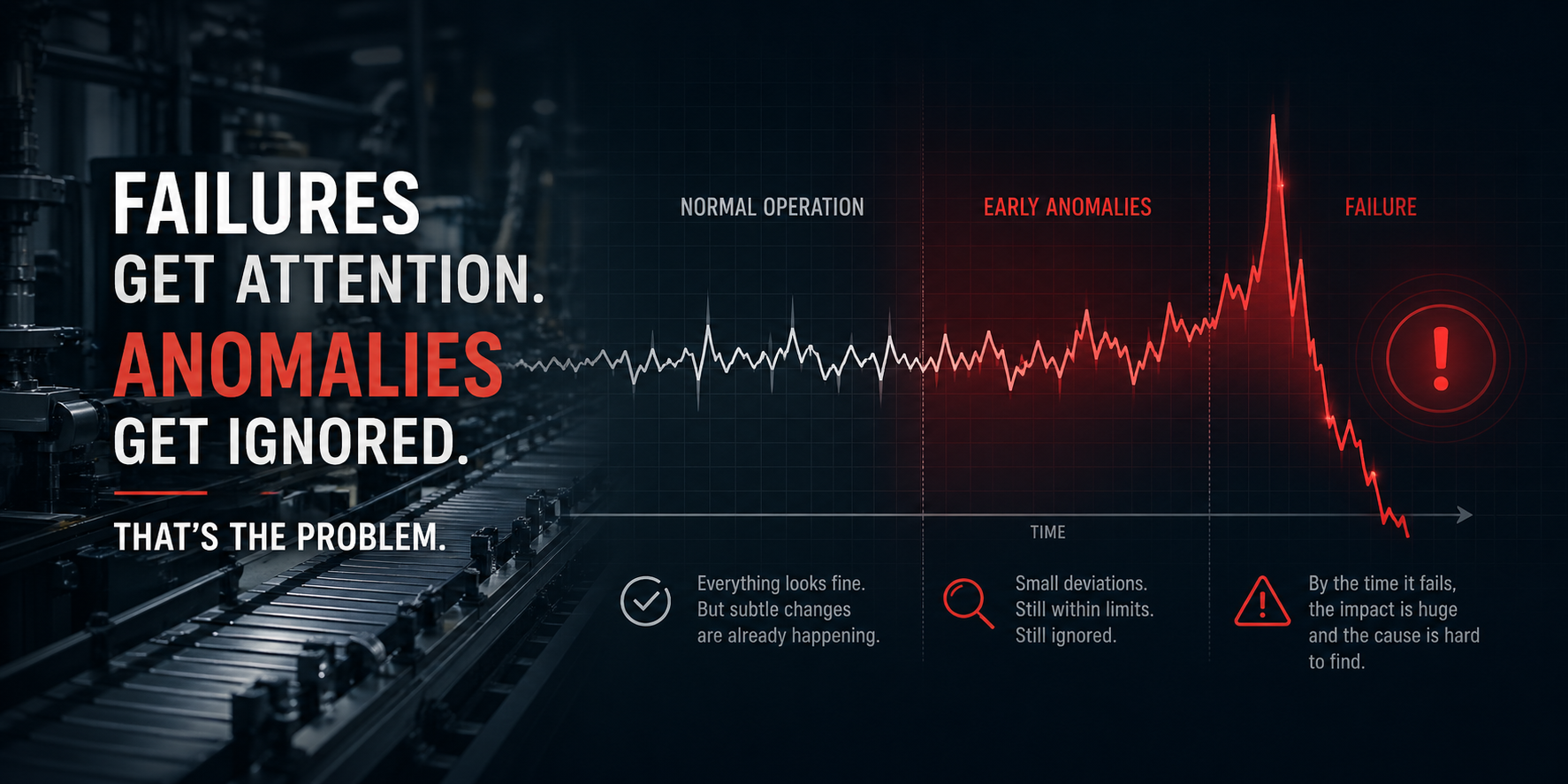
In most industrial environments, attention follows urgency.
If something breaks, alarms trigger and people react.
Failures are visible, loud and impossible to ignore.
But most inefficiencies don’t look like that.
The quiet side of production
Before a failure happens, there’s usually a long period where things are slightly off:
- A cycle time starts drifting
- A temperature fluctuates more than usual
- A machine hesitates for a fraction of a second
- A signal behaves differently—but still within thresholds
Nothing stops, nothing triggers an alarm, so everything looks "fine".
And that’s exactly why it gets ignored
These small deviations don’t create urgency.
They don’t interrupt production, don’t escalate and don’t demand attention, at the end they get normalized.
Over time, they become part of “how the line runs.”
Failures are the end of the story
When a breakdown finally happens, it feels like a sudden event, but it rarely is.
What we call a “failure” is often just the point where the system can no longer absorb the accumulation of small issues.
By then:
- the root cause is harder to trace
- the impact is higher
- and the response is reactive
The real problem isn’t the failure
It’s everything that came before it and was ignored.
Most plants are very good at reacting to failures.
Far fewer are set up to:
- detect early deviations
- understand behavioral changes in machines
- or act before something escalates
Not because the data doesn’t exist but because it never becomes visible or urgent.
Why this layer is critical
These early deviations don’t stop production or trigger alarms.
And that’s exactly what makes them so important.
Because they are the only moment when:
- the system is still stable enough to observe clearly
- and the cost of intervention is still low
Once a failure happens, all of that changes, all this signals get noisy and the all these effects overlap.
A different way to think about it
Failures tell you something went wrong, but they don’t tell you when the problem actually started.
The real opportunity is earlier when the system begins to deviate, even slightly.
That’s where:
- patterns are still visible
- causes are still traceable
- and action is still simple
What gets attention defines what gets fixed
If your systems only highlight failures, your teams will always operate reactively.
If early deviations become visible and understandable, you shift that dynamic.
From:
- reacting to breakdowns
To:
- addressing problems while they’re still small
Failures get attention, anomalies get ignored and that’s why the same problems keep coming back.
Want to learn more?
Case Studies
How Leading Companies Transform their Operations
Real-world examples of operational excellence achieved through our platform
Drive measurable results. Without operational friction.