See the drift before the failure
Detect developing problems in rotating equipment, filtration and utilities from the process signals already available, well before a threshold alarm would fire.
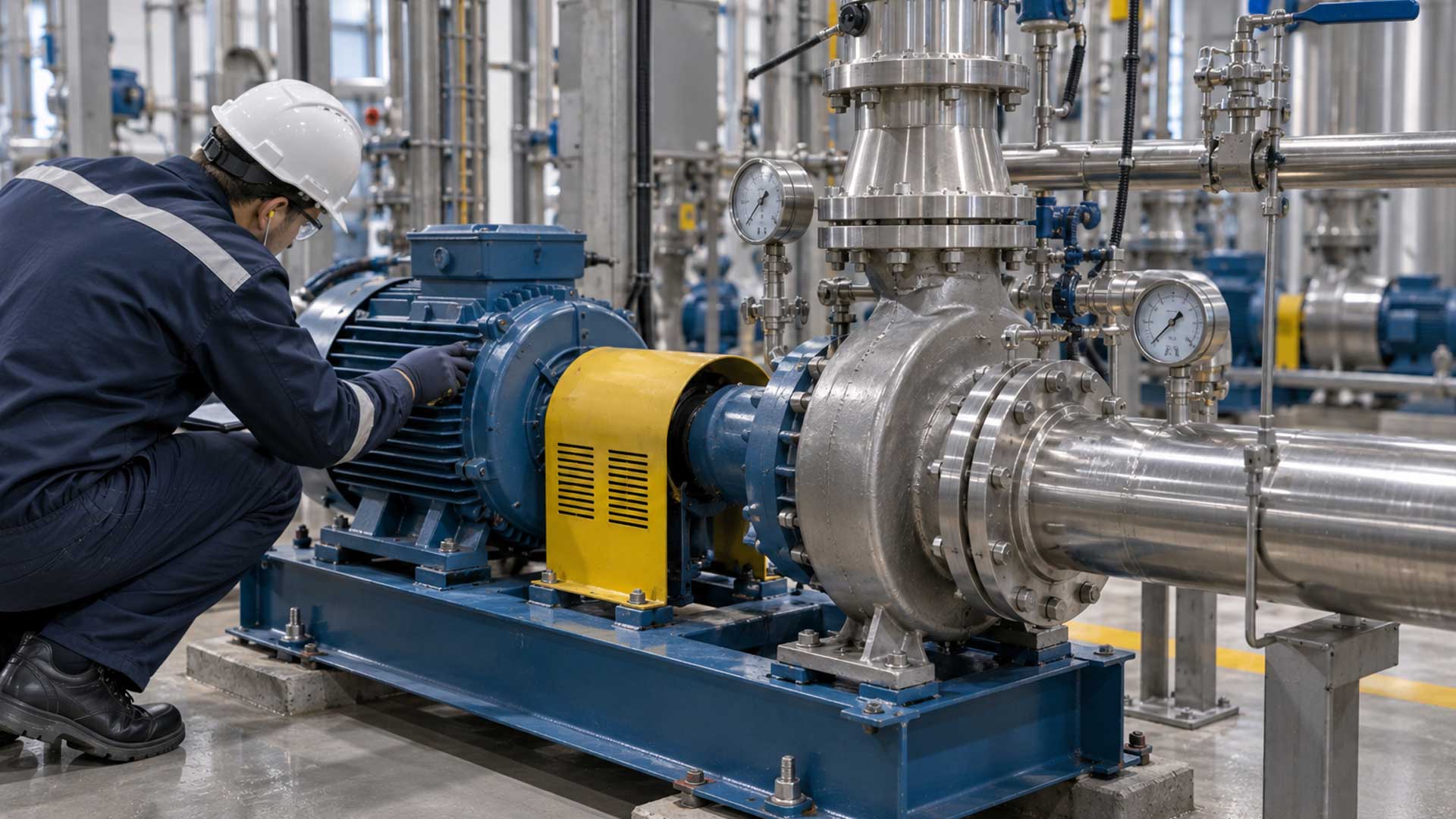
Alarms fire when it is already too late
Threshold alarms are designed to protect equipment, not to give warning. A pump, separator or membrane usually degrades gradually, and the signals show it long before any limit is crossed. Without a way to see that drift, maintenance stays reactive and shared utilities remain a single point of failure for the whole site.
- Threshold alarms trigger only once damage is likely
- Gradual degradation invisible in day-to-day trends
- Utility failures affect every line at once
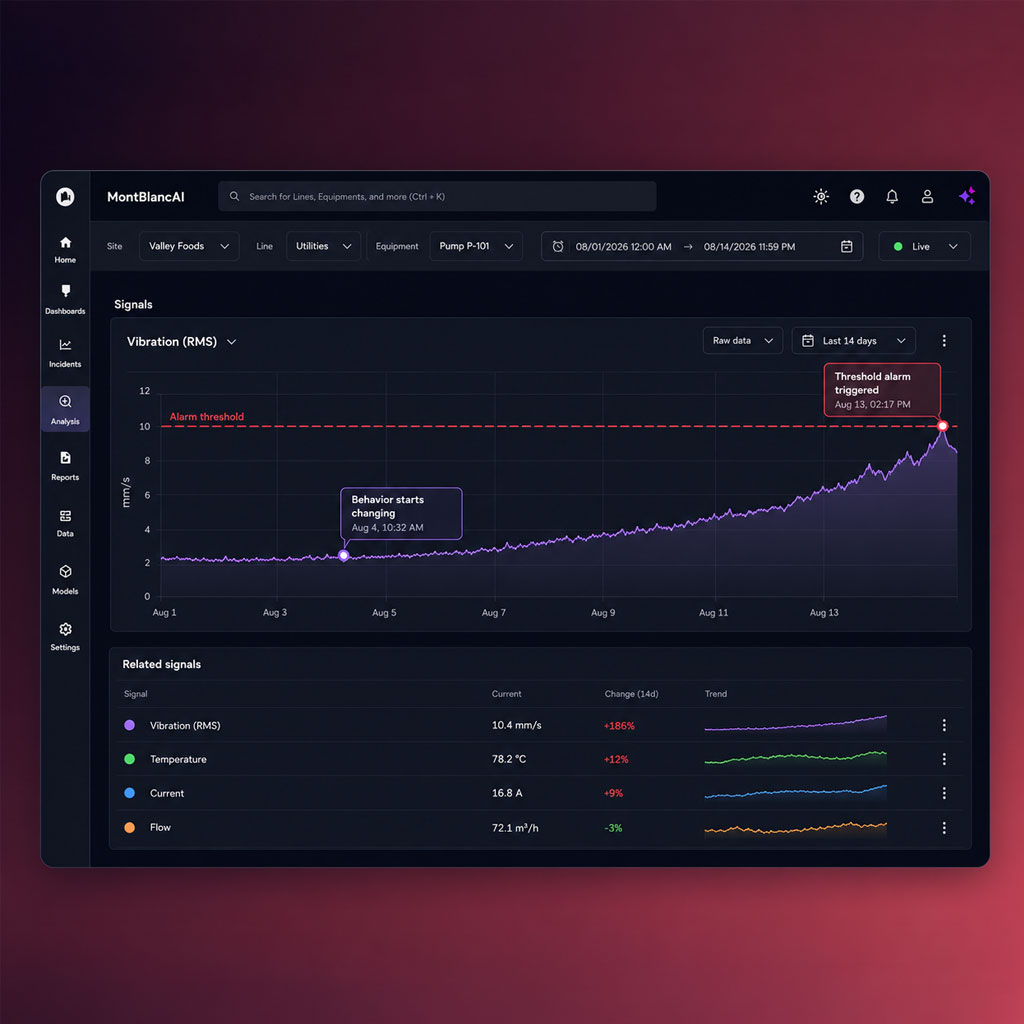
Plan maintenance around evidence, not intervals
Recognize developing problems early enough to schedule work rather than react to a stoppage.

Warn before the limit
Detect gradual change in equipment behavior while there is still time to plan an intervention.

Protect critical utilities
Monitor compressors, refrigeration and other shared systems whose failure affects the entire site.

Extend intervals with confidence
Base service decisions on how an asset is actually behaving rather than on a fixed calendar.
Condition insight from process signals
MontBlancAI evaluates how equipment signals behave relative to normal operation, so slow deterioration becomes visible without additional instrumentation.
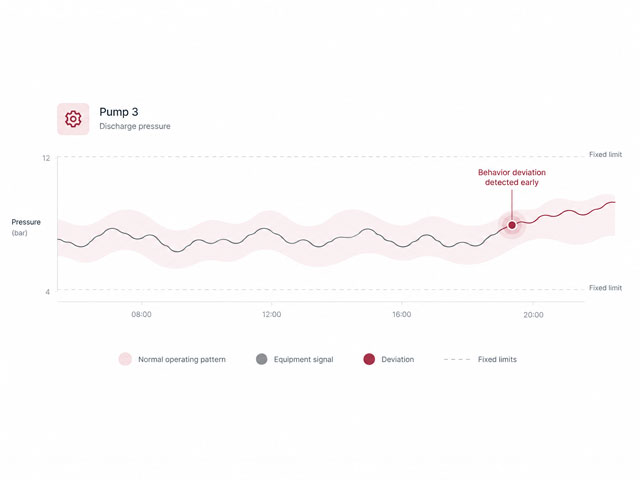
Behavior-Based Monitoring
Equipment assessed against its own normal operating pattern rather than against fixed thresholds alone.
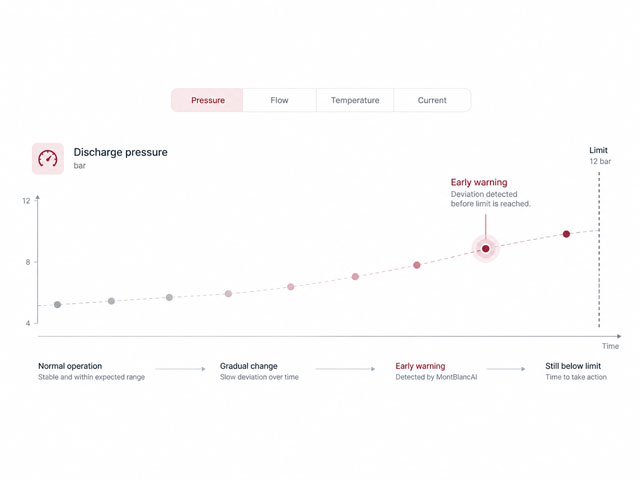
Early Deviation Warning
Gradual change in pressure, flow, temperature or current draw surfaced before a limit is reached.
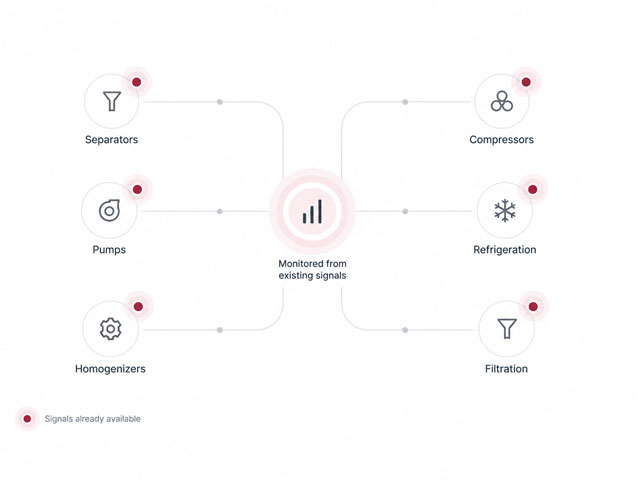
Utility and Rotating Equipment Coverage
Separators, homogenizers, pumps, compressors, refrigeration and filtration monitored from signals that already exist.
See what behavior-based monitoring changes
Move from reacting to alarms to acting on developing conditions.
Built for real production environments
See how this use case applies across different manufacturing processes and industries


Common questions about predictive maintenance
Which equipment suits this approach, whether vibration data is needed, and how it differs from alarm limits.
Which equipment is suitable for this?
Assets that expose enough signal to show gradual change. Separators, homogenizers, pumps, compressors, refrigeration, filtration and membrane systems are common starting points.
Is vibration monitoring required?
No. Process signals such as pressure, flow, temperature, current draw and differential pressure often reveal developing problems on their own. Vibration data can be added where it already exists.
How does this differ from alarm limits?
An alarm fires when a value crosses a threshold, which is often late. MontBlancAI looks at how signals behave relative to normal operation, so slow drift becomes visible before a limit is reached.
Act on drift, not on alarms