

The Answer Was in the Lab Report You Already Had
The Answer Was in the Lab Report You Already Had


You already measure everything you need
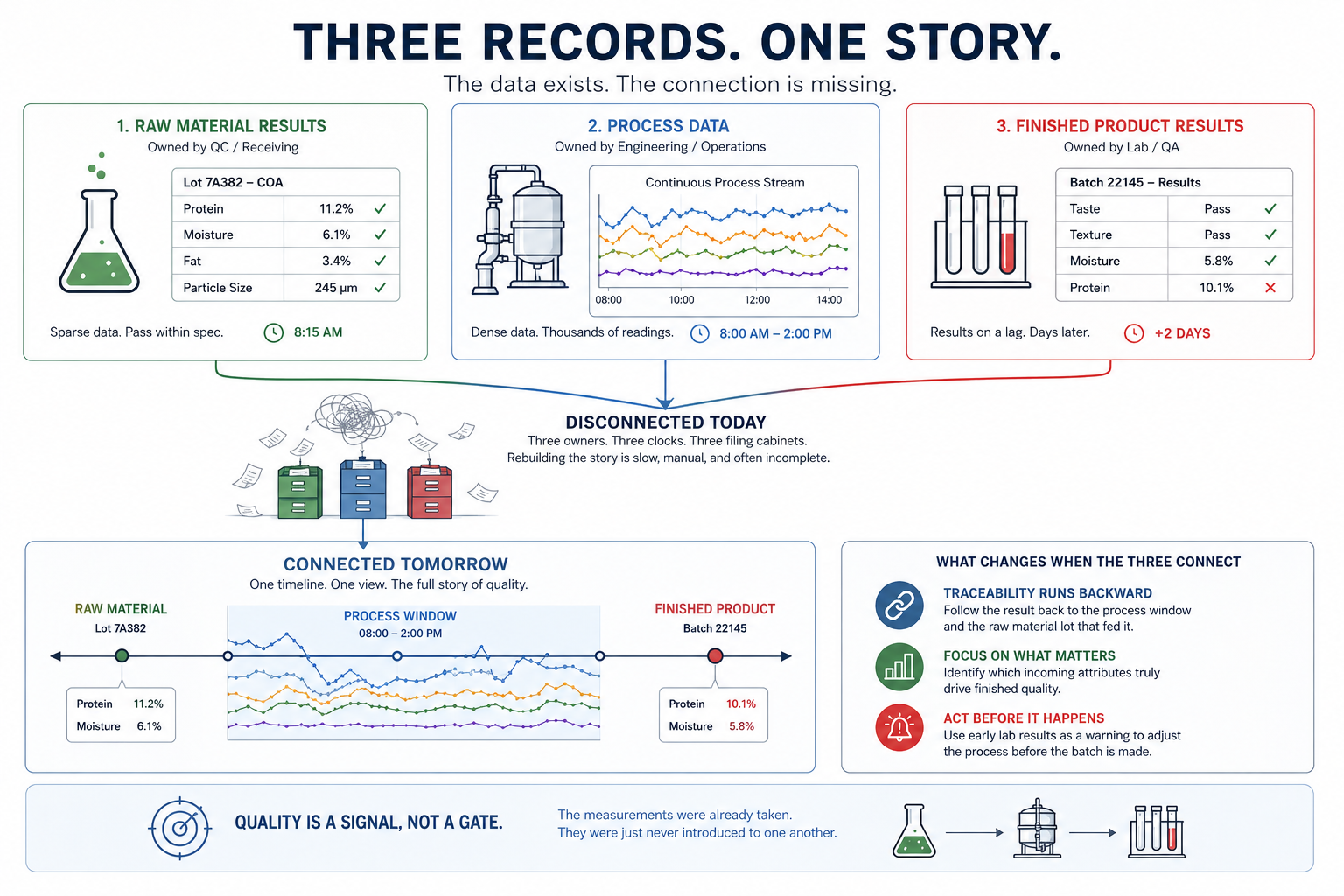
Most food and beverage plants already collect the three data sets that explain their own quality. Incoming raw materials get tested and logged in the lab system. The process itself produces a continuous stream of temperatures, pressures, speeds, and hold times. Finished product goes back to the lab for a final check against spec. End to end, the chain is already instrumented.
The catch is that these three records rarely sit in the same place, and they almost never get read together.
Three records, three owners, three clocks
Raw material results live with receiving and QC. Process data lives in the historian or SCADA system with engineering. Finished product results live back in the lab. Each set is owned by a different team, captured on a different clock, and reviewed for a different reason.
So when a plant asks why a run drifted, it is rebuilding the story from three filing cabinets that were never meant to be opened side by side. The data exists. The connection between the three does not.
The problem: the "within spec" trap
A raw material lot can pass its incoming test and still be the reason a finished batch underperforms. Specs are ranges, not points. A protein, moisture, fat content, or particle size can sit perfectly inside the acceptable band and still land at the low edge of it. If the process was quietly tuned around the middle of that band, an in-spec lot at the edge behaves like a different ingredient.
Because the certificate of analysis said pass, nobody flags it. The investigation that follows a finished product deviation almost always starts at the process, since that is where the change feels most recent and most controllable. Setpoints get nudged, operators get retrained, and the real driver, a legitimate shift in an incoming material, never enters the conversation. The plant adjusts the one thing that was working to compensate for the one thing it never looked at.
Why nobody catches it by hand
Correlating these three layers manually is genuinely hard, for three concrete reasons.
The lab data is sparse. A handful of measurements per lot or per batch. The process data is dense. Thousands of readings per hour per tag. And the finished result arrives on a lag, sometimes days after the run that produced it, by which point the process conditions that caused it have scrolled off the top of everyone's memory.
Lining up a sparse lab value against the exact process window it belongs to, across dozens of interacting variables, is not a spreadsheet job. It is a pattern search that gets abandoned halfway through, because the person doing it has a plant to run. The correlation that would explain the variation is sitting in data the plant already owns, and it stays unfound because no one has the hours to find it.
What changes when the three connect
Reading incoming results, process history, and finished results as one connected record changes three things.
Traceability runs backward. A finished product deviation stops being a mystery and becomes a chain. You follow the result back to the specific process window that produced it, and back again to the raw material lot that fed that window. The question moves from whose fault was this to here is the sequence of variation that led here.
You learn which incoming attributes actually matter. Not every spec on the COA predicts finished quality. Some tightly controlled attributes turn out to have no bearing on the final result, while a variable nobody watched closely turns out to drive it. That lets a plant tighten receiving specs exactly where they earn their keep and relax them where they were only adding cost and friction with suppliers.
Quality stops being a rear-view mirror. Once you know a particular incoming characteristic reliably shifts a finished result, an early read on the next lot becomes a reason to adjust the process before the batch is made, rather than an explanation offered after it fails. The lab result turns from a verdict into a warning you can still act on.
Quality is a signal, not a gate
The habit worth breaking is treating each lab test as a pass or fail gate and nothing more. An incoming result is the first data point in the story of how that day's product will behave. A finished result is the last data point in a chain that started at the receiving dock. The value has always been in reading the chain as one continuous thing.
The reason it rarely happens is not a lack of data. It is that the data was scattered across systems that do not talk, held by teams that rarely compare notes, on timescales that never line up. Bring the three records into one view, where the sparse lab points and the dense process stream can finally be read against each other, and the answer to most quality questions turns out to have been there the whole time. The measurements were already taken. They were just never introduced to one another.
Want to learn more?
Case Studies
How Leading Companies Transform their Operations
Real-world examples of operational excellence achieved through our platform
Drive measurable results. Without operational friction.