

Your CIP report says the wash failed. It should say why.
Your CIP report says the wash failed. It should say why.


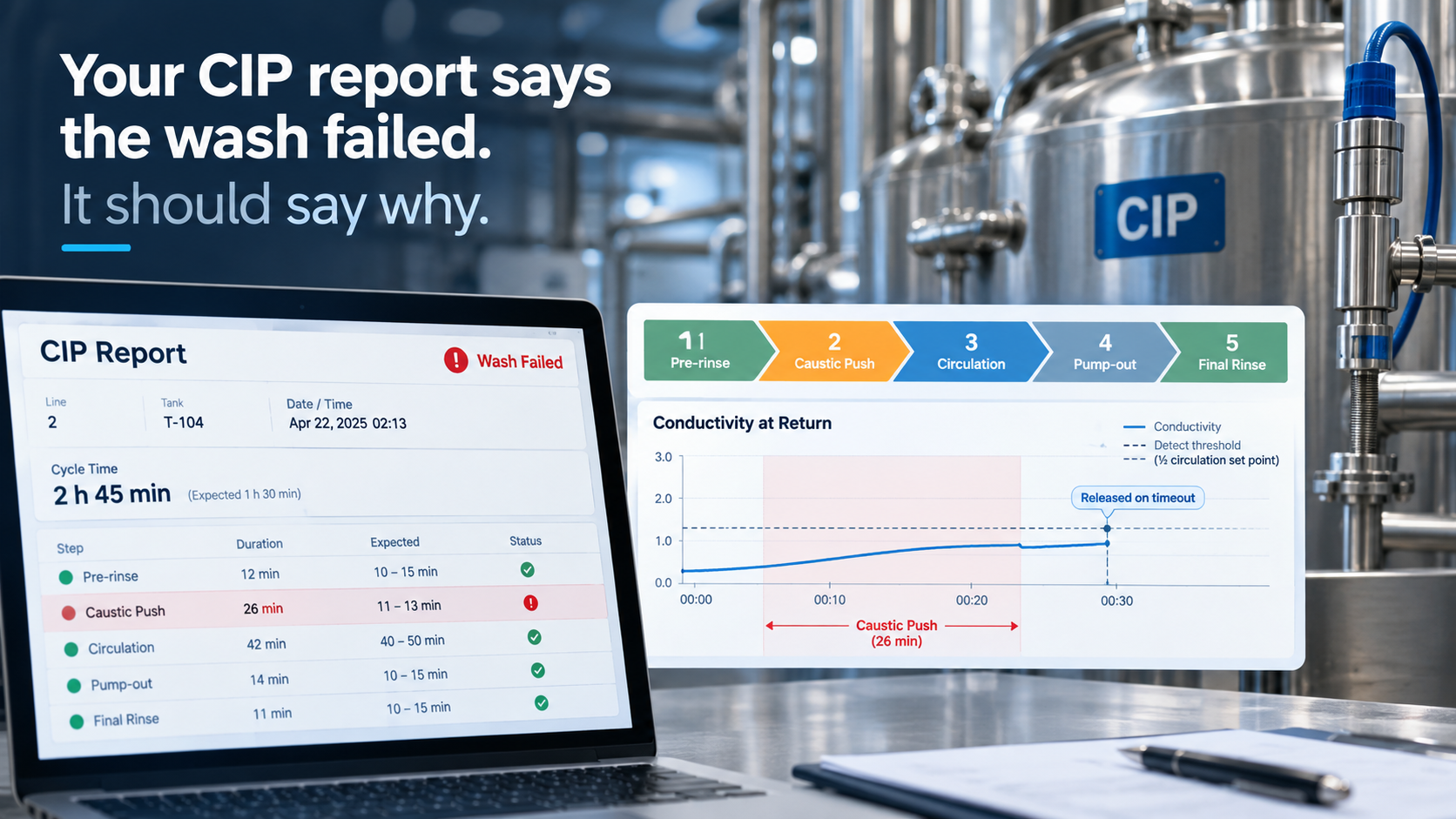
Every plant we work with has a version of the same meeting. Somebody stands up and explains what happened on the line overnight. If a CIP ran long, the question that comes back is never "did it run long." It is "what happened, and what are we doing about it before the next wash."
That is a much harder question, and most reporting stops one step short of it.
Three levels of answer
There is a ladder here, and it is worth being explicit about which rung your reporting is on.
Level one: the wash failed. The cycle took two hours forty-five when it usually takes ninety minutes. True, and already known by everyone on the floor.
Level two: this step failed. The caustic push ran long against its own history. This is genuinely useful. It narrows a two-hour window down to one named step, and it is where good anomaly detection gets you.
Level three: the step was waiting on this signal, and the signal did this. Conductivity at the return climbed slowly and stalled below the threshold the step waits on. It never crossed. So the step sat there, doing exactly what it was programmed to do, until the timeout released it.
Level three is the one that produces a work order.
What that looks like in practice
Take a three-step wash on a batch tank circuit, the kind that runs several times a day and whose timing is stable enough that a deviation stands out.
The caustic push on a circuit like this is typically a tight window, say eleven to thirteen minutes from dose to detection at the return. One night it takes twenty-six. The wash completes, the tank is released, and the only trace left by morning is a cycle time that looks wrong.
A level-two report gets you to the step: the push ran roughly twice its normal length, and the rest of the stages were unremarkable. That alone is worth having. But the useful question sits one layer down. A caustic push ends when conductivity at the return crosses a detect threshold, typically set around half the circulation set point. If the step ran long, the chemical arrived late at the sensor, or it never arrived at the concentration the logic was looking for.
Put the conductivity trace next to the step boundaries and the branch is short. A slow, steady climb that eventually crosses points at dosing: a trimming valve not opening fully, or recovered caustic coming back weaker than the set point assumes. A climb that stalls flat and only releases on timeout points at the circuit or the instrument: a restriction, a partially open valve, or a probe that has drifted and is no longer reading true.
Three different findings, three different work orders, and all of them cheaper to act on before the next wash than after it.
Why the gap exists
This is not an oversight in anybody's monitoring. It is a consequence of how the data arrives.
Anomaly detection compares a wash against its own history and tells you where the shape changed. That is a statistical question, and it is answerable from trends alone. "Why did the step wait" is a different kind of question. Answering it needs three things joined together:
- Step-level segmentation. Not "the wash," but every stage of it, split out and timed: pre-rinse, caustic push, circulation, pump-out, recovery, drains, final rinse. You cannot attribute a delay to a step you are not measuring.
- That circuit's own baseline. A caustic push has a normal range, and it is not the normal range of the circuit next to it. Twenty-six minutes only means something against the twelve that circuit usually takes.
- The release condition from the controller. The wash logic already encodes what each step is waiting for: a conductivity threshold, a temperature, a time. Read that out of the program, and you know which signal to put next to the delay.
None of this is exotic. Every one of those inputs already exists in the plant. The work is joining them so the report can carry the reasoning, instead of leaving it to whoever opens the trends at seven in the morning.
The test we use
A CIP report is doing its job when the person reporting out can read it in ninety seconds and leave with an action, not an observation. "Line 2 CIP ran long" is an observation. "The caustic push ran twenty-six minutes, conductivity at the return stalled below the detect threshold and released on timeout, check the dosing valve and the return probe before the next wash" is an action, and it names the tag.
Want to learn more?
Case Studies
How Leading Companies Transform their Operations
Real-world examples of operational excellence achieved through our platform
Drive measurable results. Without operational friction.